Friday, July 30, 2010

Installing Pixel Qi reflective screen on Samsung N150 netbook

This is a departure from my other posts, but I'm pretty excited about this sunlight reflective screen I just bought and installed. It's more than a year ago since I first looked into the availability of laptop screens that reflect light, rather than filter it the way LCDs do. What's the big deal? Well, as someone who loves sitting outside, under a tree or wherever, reading, blogging, writing papers, Facebooking, etc. it gets frustrating when everytime the sun comes out from behind a cloud, I have to squint and reorient my laptop. Now with the Pixel Qi screen, I can read my computer like it's a book, while doing all those computery things.

Finally, three weeks ago I discovered a blog post (on the day it was written) revealing that a company called Pixel Qi was selling sunlight reflective screens through MakerShed, a DIY computer warehouse in California. After a few hours researching how to do the installation, I bought one.

Here's a little photo blog showing how to do the installation.
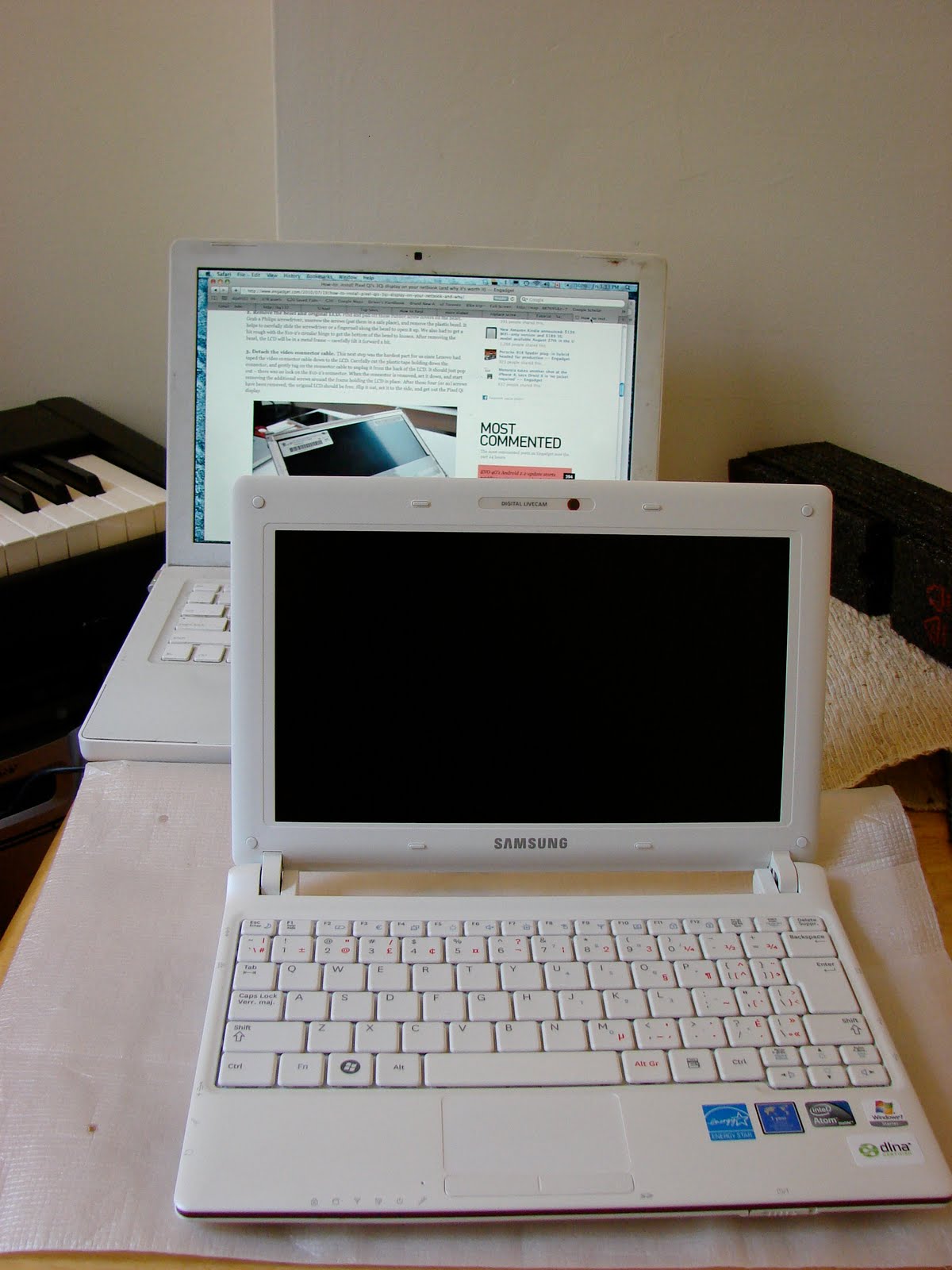
Set up the netbook on the soft packaging material to prevent scratching the seashell exterior finish. I loaded the installation instructions for a similar netbook on my Mac for easy reference. It's good to read a few different accounts of how to do this before attempting it yourself. Little tips help you avoid silly errors that you'd never think to watch out for before it's too late.


Make sure you have all the tools you need, and a suitable workspace before starting the install. It sucks to get halfway through and realize you're missing something you need to get to the next step. Here I have a clean cream cheese container for holding small parts (specifically screws, and screw covers which are held on by adhesive that needs to be kept dust-free. ) The student and library cards come in handy in for gently separating the bezel from the screen.


Careful not to crack the bezel when easing the card in and separating the bezel from the back cover. I used my fingernail to create a little gap, wide enough to slide in the card. Then used the wide surface area of the card to distribute pressure over a wider portion of the bezel to avoid cracking it.
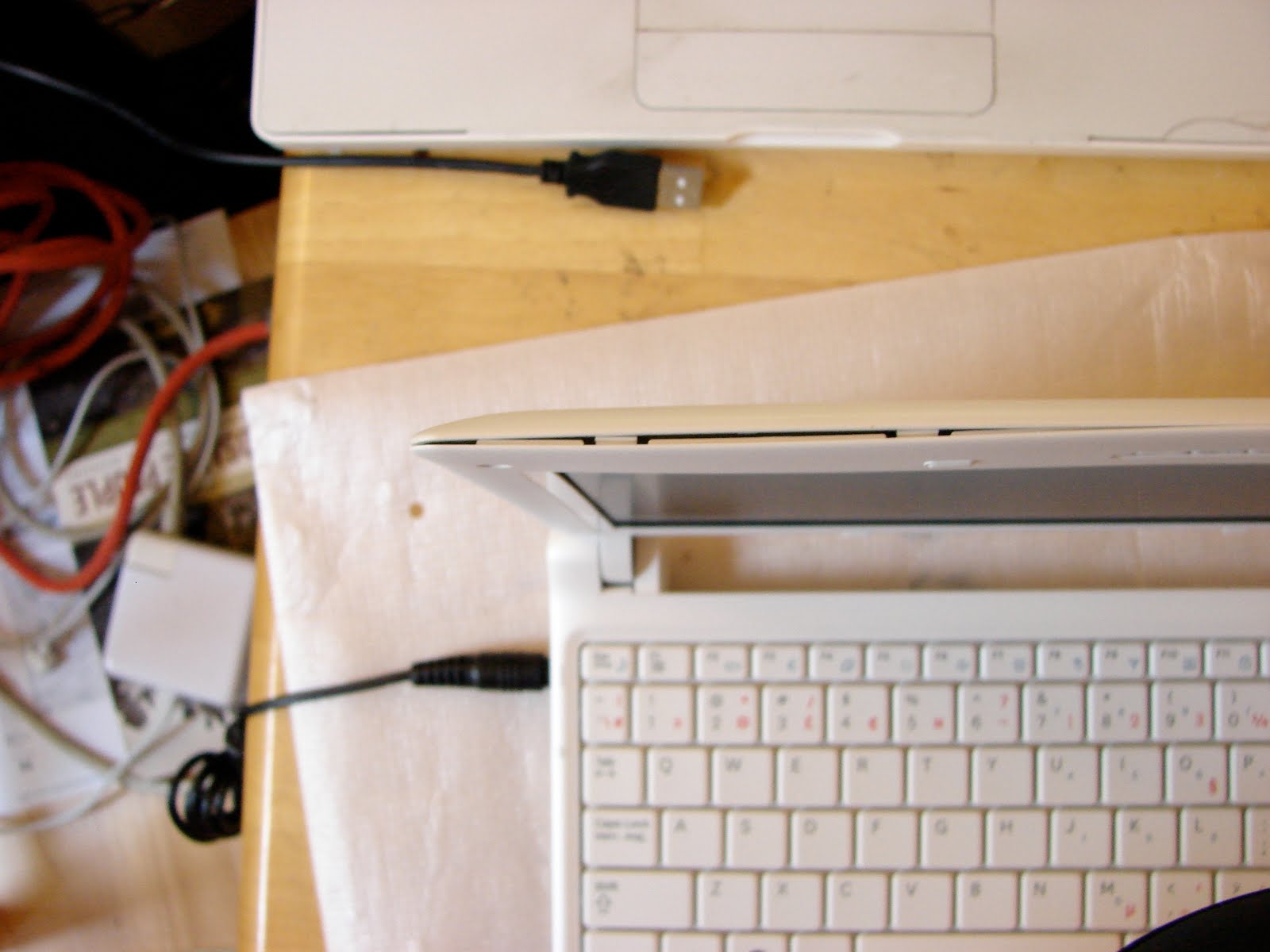
You can see the clips through the space the cards create. Gently pull the two sides apart and the clips give way (eventually... though the ones on the bottom were stickier and needed so much force I was worried about breaking something. Be careful not to let your hand fly off after the clips give way. You can avoid this by bracing your arm against another part of the netbook, or the table.)

Once you have the bezel off, it looks like this, and you can set to work on the screws. Don't do what I did, and forget which screws came from where. There are short ones and long ones, which need to back in the holes they came from.


Then lift the normal screen away from the back cover, letting the tape peel off the back of the screen. Sometimes you need to pull it. Be careful not to pull it in a way the strains the webcam connector.

Remove the tape covering the pin connector.

You can do all this without removing more than the single piece of tape that covers the pin connector. There are no clips on the pin connector, so just gently ease it out.


Connect the new screen. Be careful to not to scratch or drop a screw driver on the screen.

Connect the power cord (which should have been disconnected right at the start, unless you like that tingly sensation of being a low voltage ground and the whiff of burning electronics.)

Now turn it on and hopefully you'll see something like this. Even better if you've hackintoshed your netbook and see an OS X desktop.


I'm such a geek.

Then reverse the process and you're laughing!

Sunday, June 27, 2010

A critique of media sensationalism


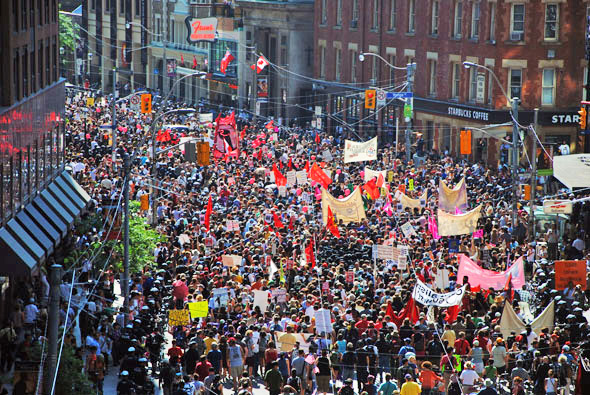
After more than 35 hours on the streets of downtown Toronto this weekend, I've gained a new appreciation for non-violent protest as a critical component of a functional democratic process. The G20 protests have left me more informed, and feeling more secure, about the ability of real, conscientious citizens to express dissent in a powerful and positive way.


Source: BlogTO, 2010

Whenever 10,000 people gather in downtown Toronto to voice opposition to a governance forum of questionable legitimacy (i.e. the G-20), that is first-page news: a hundred banners, thousands of signs, symbols and slogans expressing a common disapproval for the way our democratically-elected leaders make decisions affecting Human Rights, the Environment, and Gender Equality. So Starbucks and a few other stores had windows smashed, after the official protest was over, and by a handful of young men with their own axe to grind. That is second-page news.

Blazing police cars is an eye-catching image, understandably disturbing to many TV viewers without proper context or a perception of the miniscule scale of these acts in relation to the countless acts of peaceful free speech and collective-expression that took place over three days.

It is unsurprising that corporately-owned news agencies would lead their coverage with footage of violence and property destruction, appealing to their viewers' baser natures in a short-sighted clutch for ratings (=> advertising => profits). The corporately-owned news media, those owned (and influenced) by large corporate interests, do not, CAN not be considered independent media, the Free Press which has been a pillar of functional democracies for hundreds of years. Public news agencies, such as CBC News, are governed by a Board of Directors, who are appointed by government (CBC, 2010). In a political climate such as the one we currently have nationally, CBC loses some legitimacy as its direction comes from a government with a weakly held mandate (oh proroguement...)

Far more disturbing than the burning of police cars and smashed storefronts, are the low standards for national media reporting on the protests. Canadians deserve better; we need better if we're to have a truthful understanding of the issues, if we're to be truly politically engaged and continue to enjoy the benefits of a fair and representative democracy.

Friday, June 11, 2010

Whose roads are less safe?

One of the beautiful things about statistics is the way they can put the lie to stereotypes and popular misconceptions. If I were to ask you, which country has safer roads, South Africa a developing country with a shortage of civil engineers and weakly enforced traffic laws, or Canada?

Before you answer, consider this statement from the BBC's coverage of Zenani Mandela's death in a traffic accident on the eve of the 2010 FIFA World Cup.

"South Africa has one of the world's worst road safety records, and there are an average of 42 deaths each day on roads across the country."
-BBC, 2010

See how subtly the statement reinforces perceptions of South Africa's inferior road safety next to the rest of the world, using vagaries like "one of the worst" to link Zenani's death to a general malaise of underdevelopment. I wonder whether, after Princess Diana was killed in a car crash in Paris, any journalists were tempted to make the claim "France has one of the world's worst road safety records".

Now, consider the numbers. 42 people per day is equivalent to 15 thousand annually. This represents 1/3 of traffic fatalities in the US, whose population is 6X larger than that of South Africa. This means that there are in fact TWICE as many deaths in the US (and Canada) relative to the population as there are in South Africa. Again...WHOSE country has one of the worst safety records?

I would expect that with the high proportion of pedestrian and bicycle traffic on South Africa's roads, they may in fact be safer for the average traveler than roads in developed countries.

Tuesday, April 13, 2010

Blessing of the Bicycles


I recently attended one of those sorts of events you just don't come across all that often, and yet, in the city, strange, profound, serene, grotesque things seem to happen with heartbeat regularity. This was one such event, Blessings of the Bicycles at Trinity St. Paul's United Church (and Centre for Faith, Justice and the Arts.) It's a mouthful! But I suppose this is what it takes, or what it means, to be a thriving Christian institution in the Heart of the City. There is some amount of writing about Blessing of the Bicycles to be found on the web, to which I'll refer you. At this time of night, in this state of calm, all I feel the need to set down is a prayer, printed in a sort of bulletin given out to supplement the ritual blessing of my (well actually, my friend's friend's) bike last Sunday.

Prayer of lament, visioning, and petition

Each petition ends with "God of Life",
and you respond: "Hear our prayer."

Let us pray:
Present in a world groadingin under the excesses of consumption,
we give thanks for the simple beauty of the bicycle. God of Life...

Present in a city filled with traffic aggravation, we pray for
victims of road rage and biek theft. We ask to be mindful as we
ride, and we ask to keep calm in the face of aggression.
God of Life...

We now observe a moment of silence for all who have been injured or who have died while riding. (silence...)
God of Life...

Present in a city needing better bike lanes and respectful sharing of the transportation commons, we pray for all those who propose, design, and vote on bike-friendly roadway commons.
God of Life...

Present in a community filled with children and young people, we pray for those learning to ride. Keep them smart, safe, and visible on their neighbourhood roads. Keep drivers mindful and alert for kids on bikes. God of Life...

Present in a world of work, we give thanks for those who build, repair, and clean our bikes and who rely on bikes to earn their living. We pray for prosperity, abundance, and the sharing of skills in the biking community. God of Life...

Present in diverse and beautiful communities, we ask for Your protection and blessing on all who ride: children, elders, homeless folks, students, workers, atheletes, messengers, eco-activists, wellness enthusiasts, enjoyers of riding, and all those take to the streets, bike paths, and parks. Keep us safe as we ride. God of Life...

Blessing

May the road rise to meet you
May the wind be ever at your back
May all your journeying be joyous
May you and your bicycle be held in God's hand.

Amen.

Monday, March 29, 2010

"There is a fire burning over the Earth, taking with it plants and animals, ancient skills and visionary wisdom. At risk is a vast archive of knowledge and expertise, a catalogue of the imagination, an oral and written language composed of the memories of countless elders and healers, warriors, farmers, fishermen, midwives, poets, and saints. In short, the artistic, intellectual, and spiritual expression of the full complexity and diversity of the human experience. Quelling this flame, and rediscovering a new appreciation for the diversity of the human spirit as expressed by culture, is among the central challenges of our times." Wade Davis, 2009 Massey Lectures

Tuesday, March 23, 2010

Parsing a "No-Nonsense" Guide to Globalization

Having followed the "globalization" phenomenon for more than ten years, and TA'd a course on the topic, I've started to form an opinion... (yes, just one) that "globalization" should be renamed. Am I asking too much? Here's the trouble, the descriptor "globalization" is simply too general. It could apply equally to any number of global trends, from arts to culture to micro-finance, and yes, to the insidious creep of Western-style capitalism.

I'd suggest a different label, something like "global homogenization and cross-cultural exploitation" as a more accurate label for the cultural and economic trends currently encompassed by "globalization". Not as catchy, but also not prone to linking greater global interconnectedness with the exclusively negative outcomes associated with economic and cultural hegemony.

The danger I see is that if "globalization" is the problem, then "localization" pops out as the apparent solution. Trends towards increased global awareness and interconnectedness are not inherently a problem. However, the superficial concept of "globalization" leads to an apparently obvious panacea of "going local". Yes, re-localizing is part of the solution to global homogenization and foreign exploitation, but so equally is global awareness and interconnectedness. Peter Dicken has written an excellent text book on globally-integrated economies. I highly recommend it as a complement to the No-Nonsense Guide.


Monday, March 22, 2010

Kudos to students at the U. of Waterloo for continued creative activism in the struggle to build climate awareness.