"When you pay 80 cents for [electricity from] a wind turbine that is only operating half the time, and then have to close nuclear and coal plants to do it, you're paying twice!"
-John O'Toole, MPP for Durham, lying through his teeth to disparage Ontario's Green Energy and Green Economy Act in defense of nuclear developments in his region, Nov 23, 2010
C'mon John. We all know you're trying to protect nuclear industry jobs in your riding. But stick to the facts. Under the Green Energy Act, wind energy gets 13.5 cents (on shore), or 19 cents (off shore, OPA, 2010), plus a maximum 1 to 1.5 cent adder if the project is owned by a community or aboriginal group (OPA, 2010).
Mr. O'Toole went on to criticize the Liberals' estimate of 50,000 green jobs being created in the renewable energy sector, saying that these come at the expense of 56,000 jobs lost in other sectors, such as steel smelting and nuclear. Well, John. That's kind of the POINT. People don't want the products those companies supply! We don't want more nuclear plants. We don't want more cars and road infrastructure. We do however, want to live in a Province where people can earn a decent wage making things of value.
Tuesday, November 23, 2010

Thursday, October 28, 2010
FORD FOCUS - Chapter 1
Ford. The name that has become synonymous with "idiot"
So let me get this straight. Mayor Ford is going to abolish the $60 vehicle registration tax, saving each taxpayer a maximum of about $60 every four years. Yet he plans to build out road infrastructure at a cost of $700 Million over 4 years.
Oh. My. God.
Seriously. Oh. My. GOD.
No.
So let me get this straight. Mayor Ford is going to abolish the $60 vehicle registration tax, saving each taxpayer a maximum of about $60 every four years. Yet he plans to build out road infrastructure at a cost of $700 Million over 4 years.
Oh. My. God.
Seriously. Oh. My. GOD.
No.
Sunday, October 17, 2010
Acoustic space and the work of Philip Beesley
One of these days, I'm going to create a "sound archive" blog, for sharing this stuff with a more targeted audience. But in the meantime, I'll post this here.
I was at the keyboard tonight, and created a sound that I could imagine using as a kind of "acoustic backdrop" in a worship setting, or perhaps for a communal prayer setting as Taizé seeks to be.
The sound quality of this sample is very good, so it's a large file. But if you have a nice sound system, and a quiet place to listen, I thought you might enjoy just putting this on in the background. It's not a "song", just something to fill the acoustic space, and hopefully has a calming effect.
http://dl.dropbox.com/u/8848985/Analogue%20Basic%20with%20AVerb.aif
There's an architect in Toronto whose work I've found particularly inspiring lately. I don't know how many of you will resonate with the work of Philip Beesley, but personally I'm not aware of anyone who is as conscious of the influence of environment, that is, of form, space, and atmosphere, on spiritual well being as this man.
http://www.youtube.com/watch?v=v86B9Nz_LVU
The sound quality of this sample is very good, so it's a large file. But if you have a nice sound system, and a quiet place to listen, I thought you might enjoy just putting this on in the background. It's not a "song", just something to fill the acoustic space, and hopefully has a calming effect.
http://dl.dropbox.com/u/
There's an architect in Toronto whose work I've found particularly inspiring lately. I don't know how many of you will resonate with the work of Philip Beesley, but personally I'm not aware of anyone who is as conscious of the influence of environment, that is, of form, space, and atmosphere, on spiritual well being as this man.
http://www.youtube.com/watch?
Sunday, October 3, 2010
Emily Pilloton on getting past "Going Green"
This is one of the most important statements I've heard on sustainability in years, its emphasis on "green products" notwithstanding. It's so good in fact, I transcribed it from the interview between design expert Emily Pilloton and TreeHugger Radio host Jacob Gordon.
JG - "You wrote a manifesto/rant/founding paper that was published in Core77. You defeinitely pushed some buttons in there. You touched on a bit of a sensitive nerve in the green design fanatic community, like we are over at TreeHugger. And one thing you say is that people need to get over the notion of "Going Green" (big air quotes around that). What are you predicting will happen here, and what are you saying the design community ought to be doing about this whole "Going Green" thing?"
EP - "Well I'm... okay I'm, [hesitating] I knew I was going to push some buttons with that. Y'know this is not to say that I am anti-sustainability or anti-Green Design in any way. Um...ya I was the managing editor of Inhabitat... and a lot of my own personal furnature designs [were] very much rooted in environmental responsibility. But the point that I'm trying to make is that sustainability is much bigger than that, it's much bigger than... y'know, using bamboo to design your coffee table and then calling it a day.
Y'know so much of what we talk about within sustainability and physically going green, which is all the eco-initiatives. They're all about "how" we're designing: What we're design with; What the manufacturing process is, what's the embodied energy. And these are all "how" questions. "How" are we designing.
What I sort of hope for the next wave of sustainability is that we're talking about what we're designing in the first place. I refer to this as the Bamboo Coffee Table Paradox~, where we're using these great green materials, and, y'know, maybe this is more environmentally sensitive, and you can call it Green Design, but... do we really need more coffe tables? And that market is always going to be there. It's never going to go away. But as designers I think we have a responsibility, not just to look at how we're making things that we'll always gonna keep making, and to reorient, or to change the question, but what are we designign in the first place, What are we putting out there in the world? And are those things socially relevant. Are they improving life; are they empowering people? Are they enabling anything beyond that immediate function. And that's sort of my pet peeve, is that, we're not talking about the substance, we're talking about just the process.
I would go so far as to say we don't need new coffee tables. We need things like the HippoRoller, and we need systems and new economies, and new enterprises that can support, y'know, ventures in the developing world, but that are not necessarily rooted only in environmental initiatives."
The full interview can be found in the TreeHugger Radio archives, podcast 58 from 2/5/09.
Friday, July 30, 2010
Installing Pixel Qi reflective screen on Samsung N150 netbook
This is a departure from my other posts, but I'm pretty excited about this sunlight reflective screen I just bought and installed. It's more than a year ago since I first looked into the availability of laptop screens that reflect light, rather than filter it the way LCDs do. What's the big deal? Well, as someone who loves sitting outside, under a tree or wherever, reading, blogging, writing papers, Facebooking, etc. it gets frustrating when everytime the sun comes out from behind a cloud, I have to squint and reorient my laptop. Now with the Pixel Qi screen, I can read my computer like it's a book, while doing all those computery things.
Finally, three weeks ago I discovered a blog post (on the day it was written) revealing that a company called Pixel Qi was selling sunlight reflective screens through MakerShed, a DIY computer warehouse in California. After a few hours researching how to do the installation, I bought one.
Here's a little photo blog showing how to do the installation.
 Set up the netbook on the soft packaging material to prevent scratching the seashell exterior finish. I loaded the installation instructions for a similar netbook on my Mac for easy reference. It's good to read a few different accounts of how to do this before attempting it yourself. Little tips help you avoid silly errors that you'd never think to watch out for before it's too late.

Make sure you have all the tools you need, and a suitable workspace before starting the install. It sucks to get halfway through and realize you're missing something you need to get to the next step. Here I have a clean cream cheese container for holding small parts (specifically screws, and screw covers which are held on by adhesive that needs to be kept dust-free. ) The student and library cards come in handy in for gently separating the bezel from the screen.


Careful not to crack the bezel when easing the card in and separating the bezel from the back cover. I used my fingernail to create a little gap, wide enough to slide in the card. Then used the wide surface area of the card to distribute pressure over a wider portion of the bezel to avoid cracking it.
 You can see the clips through the space the cards create. Gently pull the two sides apart and the clips give way (eventually... though the ones on the bottom were stickier and needed so much force I was worried about breaking something. Be careful not to let your hand fly off after the clips give way. You can avoid this by bracing your arm against another part of the netbook, or the table.)
 Once you have the bezel off, it looks like this, and you can set to work on the screws. Don't do what I did, and forget which screws came from where. There are short ones and long ones, which need to back in the holes they came from.


Then lift the normal screen away from the back cover, letting the tape peel off the back of the screen. Sometimes you need to pull it. Be careful not to pull it in a way the strains the webcam connector.
 Remove the tape covering the pin connector.
 You can do all this without removing more than the single piece of tape that covers the pin connector. There are no clips on the pin connector, so just gently ease it out.

Connect the new screen. Be careful to not to scratch or drop a screw driver on the screen.
Connect the power cord (which should have been disconnected right at the start, unless you like that tingly sensation of being a low voltage ground and the whiff of burning electronics.)
Now turn it on and hopefully you'll see something like this. Even better if you've hackintoshed your netbook and see an OS X desktop.
I'm such a geek.
 Then reverse the process and you're laughing!
Finally, three weeks ago I discovered a blog post (on the day it was written) revealing that a company called Pixel Qi was selling sunlight reflective screens through MakerShed, a DIY computer warehouse in California. After a few hours researching how to do the installation, I bought one.
Here's a little photo blog showing how to do the installation.
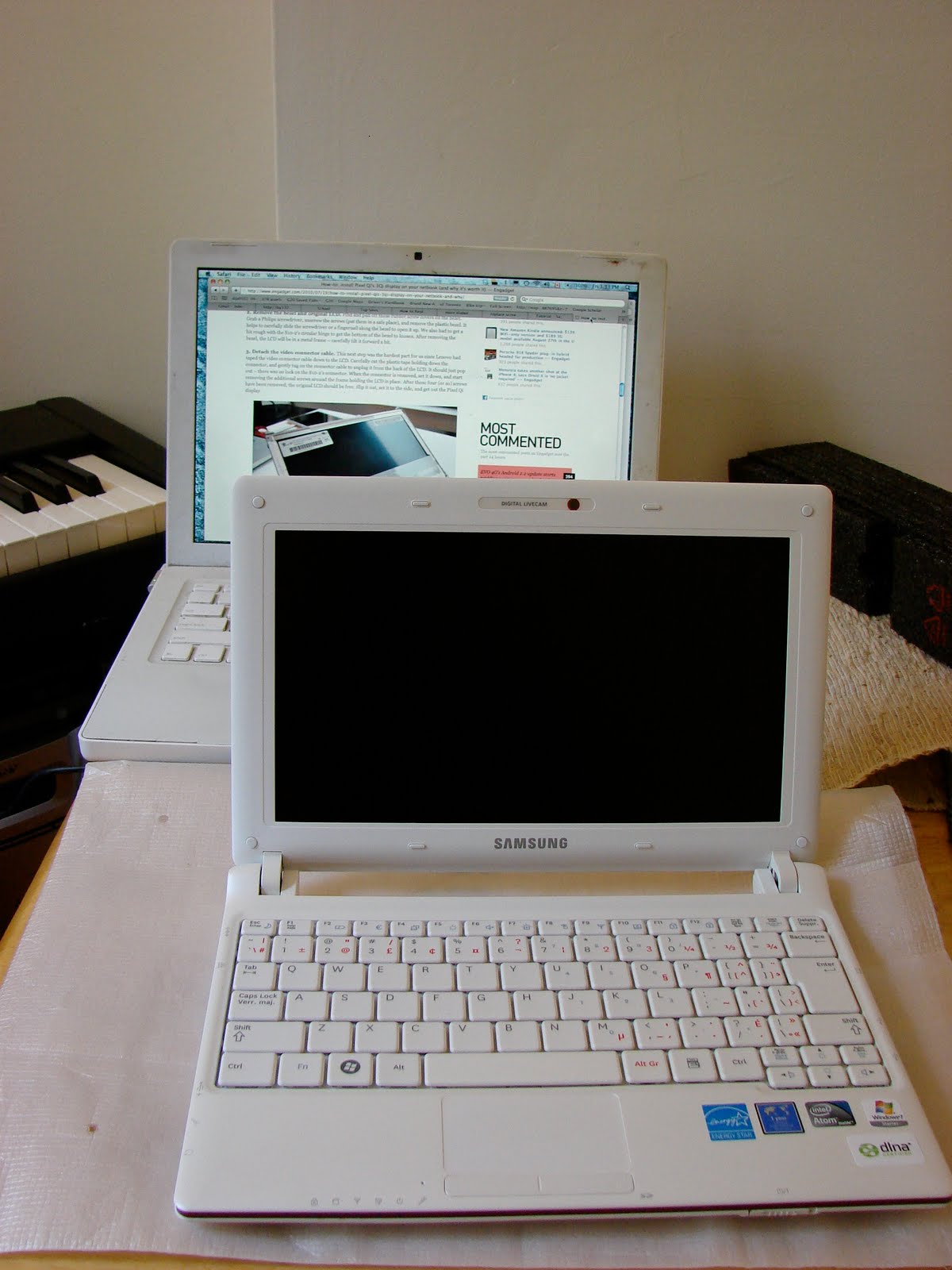 Set up the netbook on the soft packaging material to prevent scratching the seashell exterior finish. I loaded the installation instructions for a similar netbook on my Mac for easy reference. It's good to read a few different accounts of how to do this before attempting it yourself. Little tips help you avoid silly errors that you'd never think to watch out for before it's too late.

Make sure you have all the tools you need, and a suitable workspace before starting the install. It sucks to get halfway through and realize you're missing something you need to get to the next step. Here I have a clean cream cheese container for holding small parts (specifically screws, and screw covers which are held on by adhesive that needs to be kept dust-free. ) The student and library cards come in handy in for gently separating the bezel from the screen.


Careful not to crack the bezel when easing the card in and separating the bezel from the back cover. I used my fingernail to create a little gap, wide enough to slide in the card. Then used the wide surface area of the card to distribute pressure over a wider portion of the bezel to avoid cracking it.
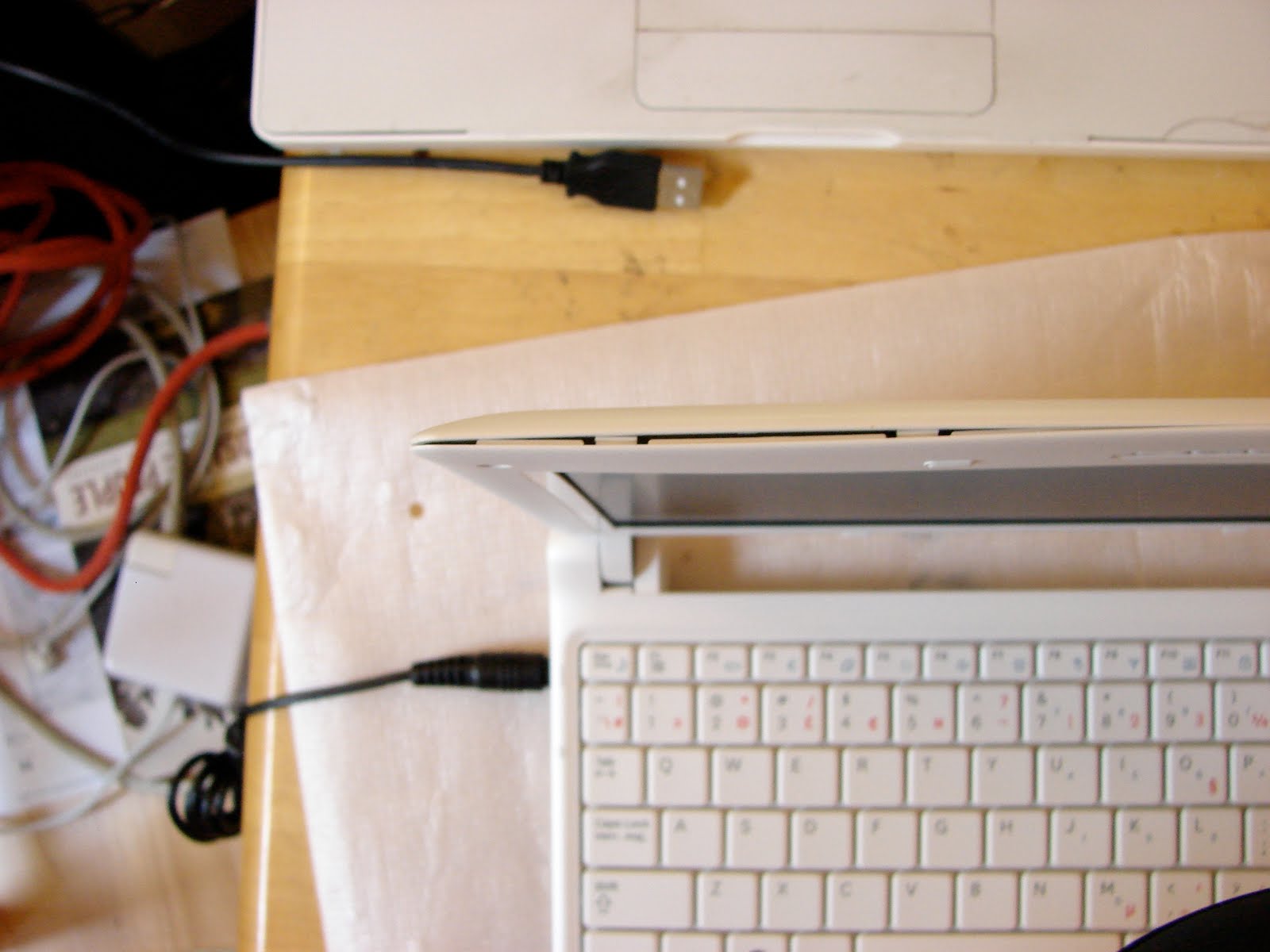 You can see the clips through the space the cards create. Gently pull the two sides apart and the clips give way (eventually... though the ones on the bottom were stickier and needed so much force I was worried about breaking something. Be careful not to let your hand fly off after the clips give way. You can avoid this by bracing your arm against another part of the netbook, or the table.)
 Once you have the bezel off, it looks like this, and you can set to work on the screws. Don't do what I did, and forget which screws came from where. There are short ones and long ones, which need to back in the holes they came from.


Then lift the normal screen away from the back cover, letting the tape peel off the back of the screen. Sometimes you need to pull it. Be careful not to pull it in a way the strains the webcam connector.
 Remove the tape covering the pin connector.
 You can do all this without removing more than the single piece of tape that covers the pin connector. There are no clips on the pin connector, so just gently ease it out.

Connect the new screen. Be careful to not to scratch or drop a screw driver on the screen.
Connect the power cord (which should have been disconnected right at the start, unless you like that tingly sensation of being a low voltage ground and the whiff of burning electronics.)
Now turn it on and hopefully you'll see something like this. Even better if you've hackintoshed your netbook and see an OS X desktop.
I'm such a geek.
 Then reverse the process and you're laughing!
Sunday, June 27, 2010
A critique of media sensationalism
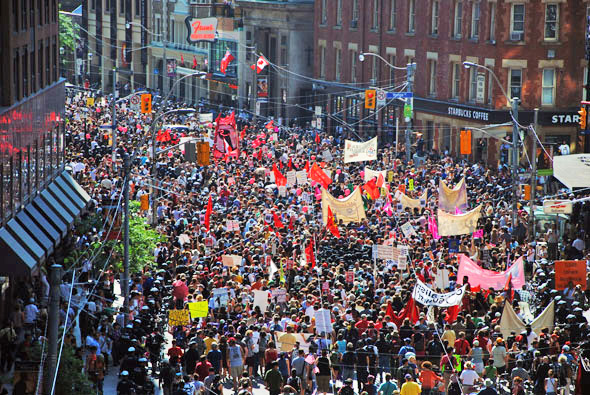
After more than 35 hours on the streets of downtown Toronto this weekend, I've gained a new appreciation for non-violent protest as a critical component of a functional democratic process. The G20 protests have left me more informed, and feeling more secure, about the ability of real, conscientious citizens to express dissent in a powerful and positive way.

Whenever 10,000 people gather in downtown Toronto to voice opposition to a governance forum of questionable legitimacy (i.e. the G-20), that is first-page news: a hundred banners, thousands of signs, symbols and slogans expressing a common disapproval for the way our democratically-elected leaders make decisions affecting Human Rights, the Environment, and Gender Equality. So Starbucks and a few other stores had windows smashed, after the official protest was over, and by a handful of young men with their own axe to grind. That is second-page news.

Blazing police cars is an eye-catching image, understandably disturbing to many TV viewers without proper context or a perception of the miniscule scale of these acts in relation to the countless acts of peaceful free speech and collective-expression that took place over three days.
It is unsurprising that corporately-owned news agencies would lead their coverage with footage of violence and property destruction, appealing to their viewers' baser natures in a short-sighted clutch for ratings (=> advertising => profits). The corporately-owned news media, those owned (and influenced) by large corporate interests, do not, CAN not be considered independent media, the Free Press which has been a pillar of functional democracies for hundreds of years. Public news agencies, such as CBC News, are governed by a Board of Directors, who are appointed by government (CBC, 2010). In a political climate such as the one we currently have nationally, CBC loses some legitimacy as its direction comes from a government with a weakly held mandate (oh proroguement...)
Far more disturbing than the burning of police cars and smashed storefronts, are the low standards for national media reporting on the protests. Canadians deserve better; we need better if we're to have a truthful understanding of the issues, if we're to be truly politically engaged and continue to enjoy the benefits of a fair and representative democracy.
Friday, June 11, 2010
Whose roads are less safe?
One of the beautiful things about statistics is the way they can put the lie to stereotypes and popular misconceptions. If I were to ask you, which country has safer roads, South Africa a developing country with a shortage of civil engineers and weakly enforced traffic laws, or Canada?
Before you answer, consider this statement from the BBC's coverage of Zenani Mandela's death in a traffic accident on the eve of the 2010 FIFA World Cup.
"South Africa has one of the world's worst road safety records, and there are an average of 42 deaths each day on roads across the country."
-BBC, 2010
See how subtly the statement reinforces perceptions of South Africa's inferior road safety next to the rest of the world, using vagaries like "one of the worst" to link Zenani's death to a general malaise of underdevelopment. I wonder whether, after Princess Diana was killed in a car crash in Paris, any journalists were tempted to make the claim "France has one of the world's worst road safety records".
Now, consider the numbers. 42 people per day is equivalent to 15 thousand annually. This represents 1/3 of traffic fatalities in the US, whose population is 6X larger than that of South Africa. This means that there are in fact TWICE as many deaths in the US (and Canada) relative to the population as there are in South Africa. Again...WHOSE country has one of the worst safety records?
I would expect that with the high proportion of pedestrian and bicycle traffic on South Africa's roads, they may in fact be safer for the average traveler than roads in developed countries.
Subscribe to:
Posts (Atom)